Swamp expedition
Mud tires, lower pressure where available, high clearance and short gearing for pulling power.
Tires, suspension and gearing shape how a vehicle handles rough ground. This explainer breaks down each setting and when it helps.
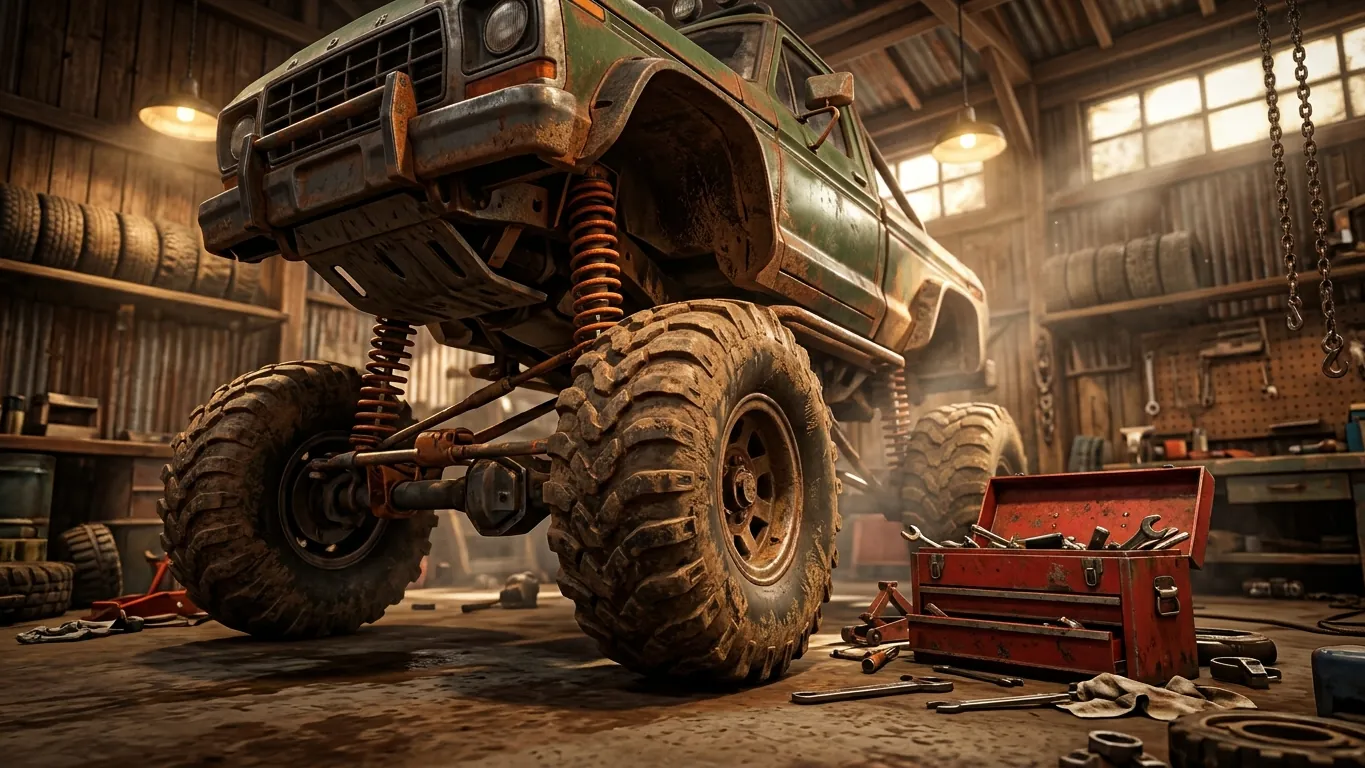
If you can change only one thing on an off-road vehicle, tires usually make the biggest difference. In many off-road games, tire types are designed for specific surfaces. Aggressive, deep-tread tires dig into mud and loose soil. All-terrain tires offer a compromise between grip off-road and stability on firmer ground. Road-oriented tires are smooth and quick on hard surfaces but struggle as soon as the ground softens.
Think about where you will spend most of your time. An expedition through swamps calls for mud-oriented tires, while a route that mixes dirt tracks and gravel roads may suit an all-terrain choice. Larger tires can also add ground clearance, though in some games they affect acceleration or handling.
Some games let you adjust tire pressure. Lower pressure allows the tire to spread out, creating a larger contact patch. On sand, snow and soft mud, this can improve flotation and grip. Higher pressure keeps the tire firmer, which usually feels more stable and responsive on hard ground.
The trade-off is control. Very low pressure can make a vehicle feel vague on firm roads and, depending on the game, may increase the risk of damage on rocks. If your game supports it, experiment with pressure for different terrain and note how the vehicle responds.
Suspension determines how well the wheels stay in contact with uneven ground. Softer, longer-travel suspension lets wheels drop into dips and climb over bumps while the body stays relatively steady. This helps on rocky trails and rough terrain. Stiffer suspension can feel more stable at speed and in corners but may lift wheels off the ground on uneven surfaces.
Ground clearance is the space between the underside of the vehicle and the ground. More clearance helps you pass over rocks, logs and deep ruts without getting hung up. Raising a vehicle, however, can raise its center of gravity, making it more prone to tipping on side slopes.
Gearing affects how engine power reaches the wheels. Shorter gearing gives stronger acceleration and more pulling force at low speeds, which helps when climbing or crawling. Longer gearing allows higher top speed but may feel weak in demanding terrain.
In games that allow gearing adjustments, crawling and expedition setups usually benefit from shorter gearing, while racing setups often lean longer to reach higher speeds on open sections. If your vehicle feels like it runs out of pulling power on hills, or tops out too early on straight tracks, gearing is worth exploring.
Use these general pairings as a starting point, then adjust to the game you play.
Mud tires, lower pressure where available, high clearance and short gearing for pulling power.
Long-travel suspension, good clearance and slow, controlled gearing.
All-terrain tires, firmer suspension and longer gearing for speed.
A balanced setup with all-terrain tires and moderate suspension settings.
 Controls and Camera Setup for Smoother Off-Road Driving
Set up your controller, keyboard or wheel and camera for off-road driving games, with tips on throttle control, dead zones and practice routines.
Read more
 Why Slow Driving So Often Wins Off-Road
An opinion piece on why patience and slow, deliberate driving often pay off in off-road games, and when it makes sense to put your foot down.
Read more
 Mastering Hill Climbs, Side Slopes and Descents
Tips for steep hill climbs, side slopes and controlled descents in off-road games, with a simple checklist to approach any slope with confidence.
Read more